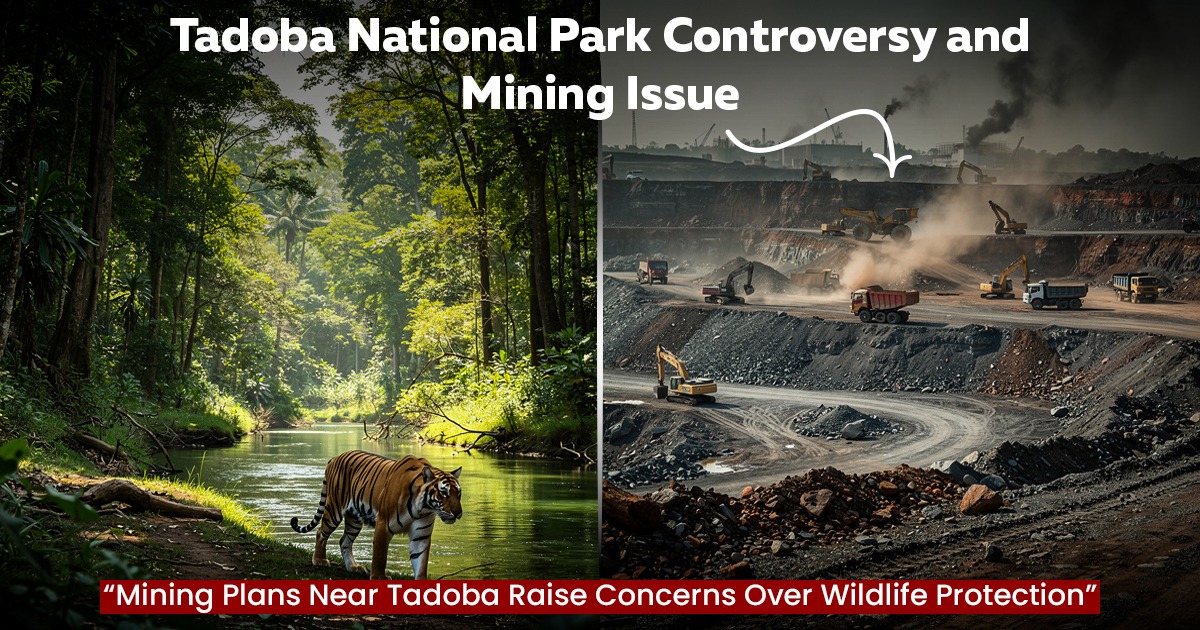
Tadoba National Park Controversy And Mining Issue
The Government of Maharashtra has given permission for iron ore mining in a tiger corridor area near Tadoba National Park. The mining will be carried out using the open-cast mining process, where the topsoil and rocks are cleared to access the minerals. This will result in the clearance of a large area of the forest, deforestation, changes in the topography of the land, and increased dust, noise, and truck traffic. Many people think that this will negatively affect the environment. This forest area of the park is home to Bengal tigers, leopards, sloth bears, deer, and wild dogs. The tiger corridor area ensures that tigers are able to migrate safely to find food and partners to breed with, thus maintaining genetic diversity. It will result in human-wildlife conflict if it is blocked. It will also impact Tadoba safaris, which are tourism activities that provide employment; therefore, people are raising questions about mining in the sensitive area of the forest.
What Did Nadir Godrej Say?
Nadir Godrej, Chairman of Godrej Industries, expressed strong concern about the mining approval. He spoke about this issue during Mumbai Climate Week. He clearly said that development should not damage national parks. According to him, economic growth is necessary for the country. Infrastructure projects are also important. However, protected forests and national parks should not be harmed in the process.
He explained that national parks are created mainly for conservation. Their purpose is to protect wildlife and natural habitats. If mining or other industrial activities are allowed in or near these areas, the purpose of national parks may be weakened. He warned that short-term economic benefits should not damage long-term environmental stability.
He also said that there is a growing trend of allowing development activities in ecologically sensitive zones. He believes this trend should be carefully examined. In his view, economic progress and environmental protection must move together. One should not replace the other. Both are necessary for India’s future growth and safety.
His View On Monetising Biodiversity
Although he strongly opposed damaging national parks, he is not against development. He supports monetising biodiversity in responsible ways. Monetising biodiversity means creating economic value from natural resources without destroying them. It means using nature in a way that also protects it.
He gave tourism as an example. The Tadoba safari allows people to see wildlife in a controlled and regulated way. Tourists pay entry fees. They stay in local hotels. They hire local guides. This creates income for nearby communities. When tourism is properly managed, it can support conservation. Money earned from tourism can improve forest protection, pay forest staff, and fund wildlife research.
He also spoke about forest-based products. Some oils and natural products come from forest resources. Companies can use these resources if they are sourced in a sustainable way. Sustainable sourcing means taking resources in limited amounts without harming the ecosystem. His company uses certain oils from forest products. He stressed that such practices must not damage biodiversity.
His main point is that earning money from nature is possible. However, the ecosystem that provides this value must not be harmed. Conservation and economic activity should support each other.
Connection To Project Tiger And Tiger Protection
During his speech, he mentioned Project Tiger. Project Tiger was launched in 1973 by the Government of India to protect the country’s declining tiger population. His uncle was associated with this program, which gives him a personal link to tiger conservation.
Project Tiger focused on protecting tiger habitats, stopping poaching, and improving forest management. Over the years, India’s tiger population increased because of this initiative. India is now recognized globally for success in tiger conservation. The program helped create tiger reserves and improve monitoring systems.
The mining proposal near Tadoba National Park is sensitive because it lies close to a tiger corridor. Tiger corridors connect different forest areas and tiger reserves. They allow tigers to move freely and maintain genetic exchange. If such corridors are damaged, breeding opportunities may be reduced, and the tiger population may weaken over time.
Many experts believe that disturbing a tiger corridor can reverse years of conservation work. The progress achieved under Project Tiger could be negatively affected if habitat connectivity is broken.
His Concerns About Pollution In India
In addition to forest conservation, he also spoke about pollution. He said that about 60 percent of Indians are affected by pollution in some way. Pollution includes air pollution, water pollution, and soil contamination. These problems can cause serious health issues. They can lead to breathing problems, heart disease, and reduced life expectancy.
He expressed concern that even coastal cities like Mumbai have high pollution levels. Coastal cities are expected to have better air quality because of sea winds, but natural conditions alone are not enough. Strong policies and proper enforcement are required to control pollution.
He said that citizens must raise their voices about pollution problems. Public discussion and awareness are important for policy change. He gave examples of Los Angeles and Beijing. These cities once had very high pollution levels. Over time, through strict government policies, improved technology, and strong enforcement, they reduced pollution significantly. This shows that improvement is possible with clear action and planning.
Need For A Strong System To Control Pollution
According to his view, one major problem in India is the lack of a single strong authority to control pollution nationwide. Different government departments handle different parts of environmental regulation. The duties and powers are shared separately by the central government and the state governments. This division can cause slow decision-making and weak enforcement.
He suggested creating a coordinated system similar to the Goods and Services Tax model. The GST system involves cooperation between the central government and state governments through a structured council. A similar framework for pollution control could improve coordination, set uniform standards, and increase accountability. It could also ensure faster implementation of environmental policies.
He believes environmental protection should not be treated as a secondary issue. It should be central to policy planning. Economic development, environmental conservation, and public health are closely linked. If pollution increases and forests are damaged, public health costs may rise. Long-term economic growth may also suffer.
The debate around Tadoba National Park is therefore not only about mining in one place. It is about how India will balance industrial growth with environmental responsibility. It raises questions about governance, conservation policy, and sustainable development. The decision in this case may influence future policies in other ecologically sensitive areas


(0) Comments: