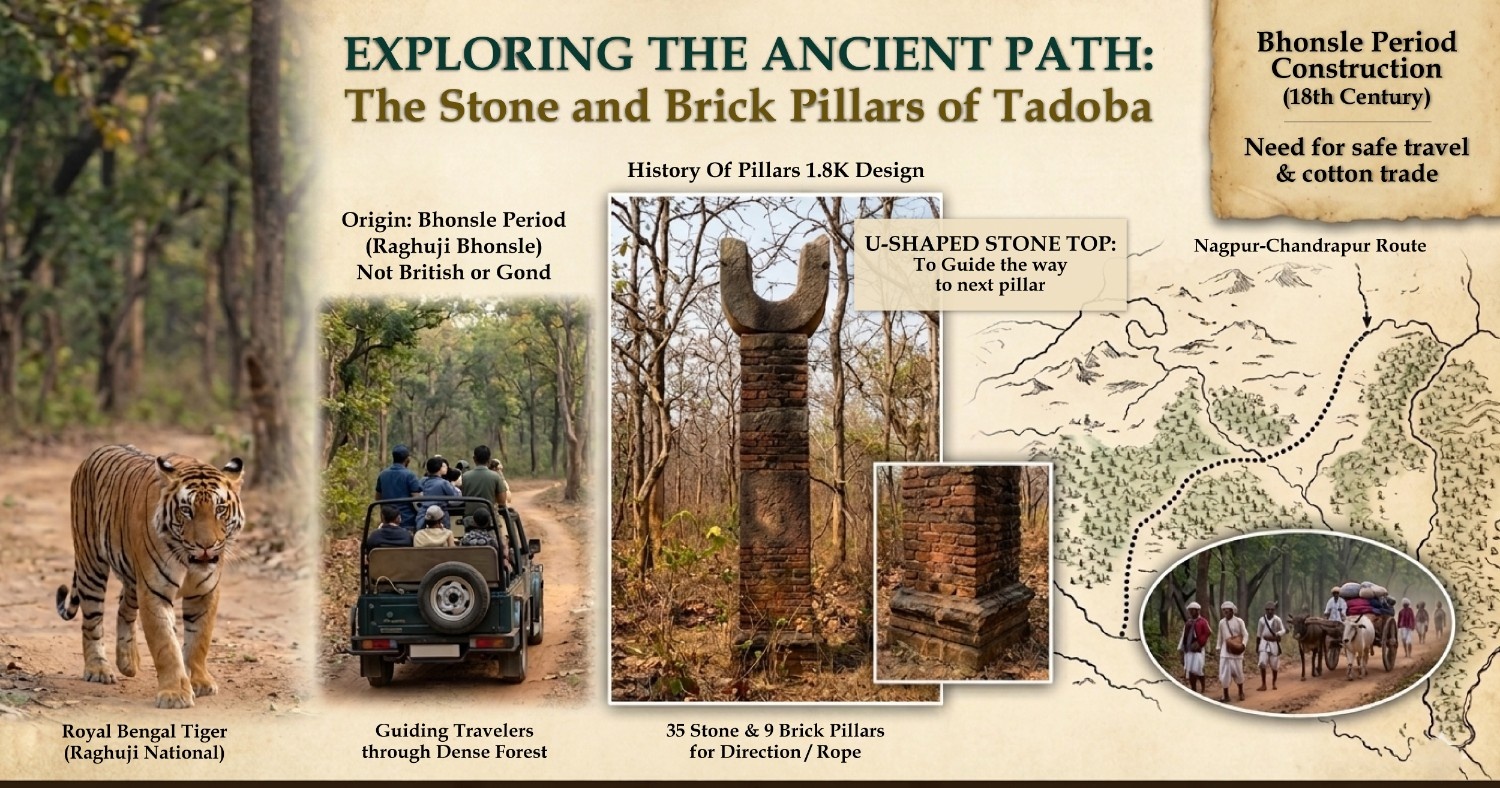
History Of Pillars Near Tadoba National Park
Tadoba National Park is a famous forest in Maharashtra known for its wildlife and nature. Many people visit every year to see animals and enjoy the forest. Tadoba safari is a common activity where visitors follow fixed paths to spot tigers, deer, and birds.
This area also has history. An old road once connected Chandrapur and Nagpur through dense forest. Travel was difficult then. Stone and brick pillars were built along this route. These pillars helped travelers find the correct path, as forest roads were unclear, making them very useful in earlier times.
Research Study And New Claim
A detailed study was done by Suresh Chopne, who has knowledge in history, geology, and archaeology. He carefully examined the pillars to understand when they were built and who built them. His study included checking different historical periods and reliable records.
He studied three main periods: the Gond period, the Bhonsle period, and the British period. He also checked old government documents, administrative records, and Gazetteer reports. These sources helped him compare facts and understand the timeline of the region.
After studying all the information, he reached a clear conclusion. He stated that these pillars were not built during the Gond rule or the British rule. According to his research, these pillars were constructed during the time of the Bhonsle rulers.
This finding is important because earlier, many people believed that the pillars were from the British period. His research gives a different and more accurate understanding based on records, structure, and historical needs. It helps people know the correct origin of these pillars.
Details Of Stone & Brick Pillars
Even today, some of these pillars can be seen inside Tadoba National Park. However, their number has reduced over time. At present, around 35 stone pillars & about 9 brick pillars are still present.
Many pillars have already been destroyed. Natural causes such as weather & plant growth have damaged them. Human activities have also caused damage. Because of this, only a limited number of pillars remain today.
The remaining pillars have a similar size & shape. Their height is nearly 15 feet, with a base thickness of about 2.5 feet. This shows that they were built using a proper plan.
The distance between each pillar is also regular. Each pillar is placed about 100 meters from the next one. Equal spacing indicates that work was planned & not done randomly.
The main purpose of these pillars was to guide travelers. In dense forest areas, it is easy to lose direction. These pillars helped people stay on the correct path. They made travel safer & easier. They also helped maintain a continuous route through the forest.
Dezign & Structure Of The Pillars
The pillars are specially designed at the top. Each pillar is provided with a “U” shaped stone structure at its top. This design was made with a purpose. There are two different ideas related to this design.
The first idea is that it was used to show the way to the next pillar. This shows a person can look at the top & decide where to go. The second idea is that it was used to keep something with a rope.
The other possible use is that of bells. If bells are put on the pillars, they can make a sound. The sound can be helpful to travelers in two ways. Firstly, it can alert them to the presence of wild animals.
Secondly, it can assist them in following the route by paying attention to the sound. This illustrates that the pillars were planned in design. They were built to guide, protect, & support travelers.
Why Pillars Are Not From The Gond Or British Period
During the Gond rule, this region was controlled in the 16th and 17th centuries, with main centers located in Chandrapur, Kalamb, & Mahur. However, there is no strong proof that regular travel routes existed between Nagpur & Chandrapur during that time.
Another important point is the use of materials. Gond constructions were mainly made using stone. However, this place has pillars made of stone & brick. This does not match their usual building style. Because of these reasons, it is unlikely that the Gond rulers built these pillars.
The British period started in this region after 1854. The British administration kept detailed records of its work. These records included information about roads, construction work, & expenses.
However, no record has been found that mentions the construction of this forest route or these pillars. At the same time, British records clearly mention other roads built in the area. This shows that if they had built these pillars, it would have been recorded.
Because there is no such record, it is unlikely that the pillars belong to the British period.
Why Pillars Belong To The Bhonsle Period
The Bhonsle rulers controlled this region during the 18th century. During their rule, there was a need for better travel and communication between different areas.
Raghuji Bhonsle expanded control in this region. As the administration increased, the movement of officials & goods also increased. This created the need for proper travel routes.
The Chandrapur–Nagpur forest route served many purposes, including government work, officials’ movement, and trade in earlier times.
At that time, Chandrapur & nearby areas were known for cotton and textile production. These goods needed to be transported to markets in Nagpur. For this reason, a clear & safe forest route was necessary.
The use of bricks in some pillars also supports this idea. The Bhonsle rulers commonly used bricks in their construction work. This matches the design of these pillars.
All these points suggest that the pillars were built during the Bhonsle period.
Importance & Need For Correction
These pillars are significant historical structures within Tadoba National Park. They represent how movement was controlled within forest regions in the past. They showed clear planning & a proper system during that time.
Some records may show that these pillars are from the British period. However, research indicates that this information is incorrect. There is a need to update records to show the correct history.
The preservation of these pillars is also important. These pillars are already damaged or have disappeared. Arrangements should be made to preserve the existing pillars. This will help the coming generations learn about this history.
Further research can also be done to give more details. This helps us learn how these pillars were built and used. These pillars can be an added knowledge for the people who are coming for the Tadoba safari. This will give historical knowledge to the people.



(0) Comments: