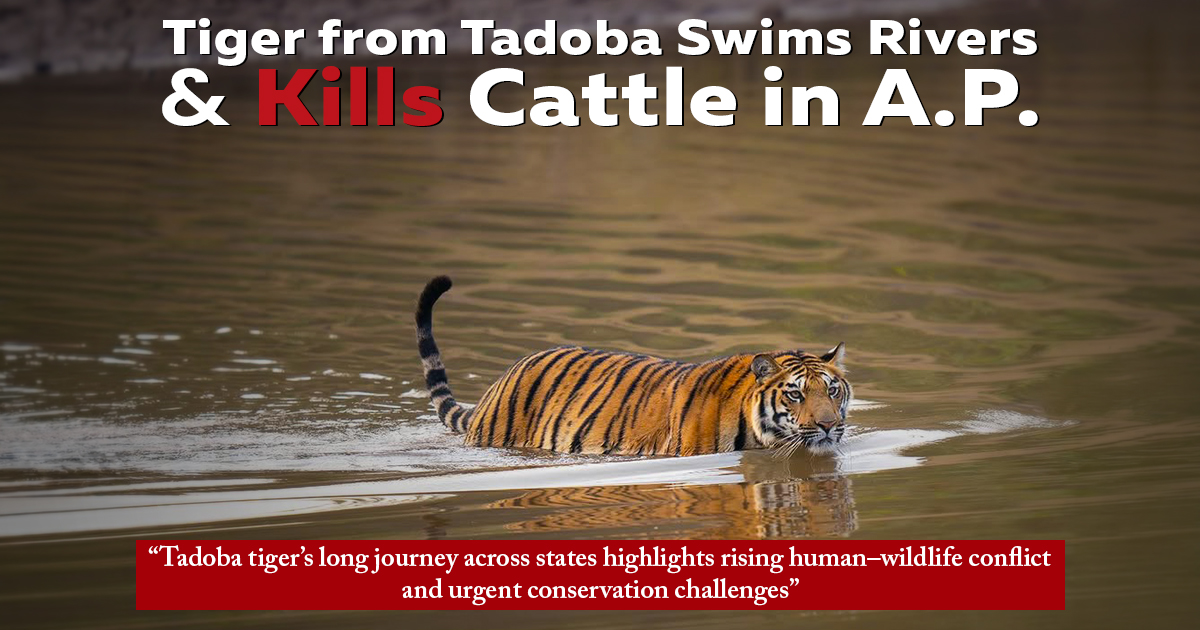
Tiger From Tadoba Swims Rivers & Kills Cattle In A.P.
The tigers from Tadoba-Andhari Tiger Reserve (TATR) in Maharashtra have traveled beyond their natural territory into areas populated by humans. The two tigers left Tadoba National Park in December 2025. The animals traveled through various territories, which included two major rivers, until they reached the East Godavari district in Andhra Pradesh, where they killed three cattle. The study shows that tigers pose a threat to humans when they leave their natural habitats and enter areas with human populations because this behavior increases the likelihood of human-wildlife conflict.
The Tiger’s Journey from Tadoba National Park
These tigers began their life in the Tadoba-Andhari Tiger Reserve located in Maharashtra. The Indian tiger reserves include Tadoba National Park as one of its most recognized tiger reserves. The park attracts numerous visitors who make Tadoba safari bookings because it has a wide range of wild animals, along with tigers. Two male tigers left Tadoba in December 2025 to start their journey. One of the tigers remained in the reserve territory while the other tiger proceeded to travel toward the eastern direction. The tiger traveled through multiple regions by moving through various forests and other territories. It reached completely different territory, which goes beyond the boundaries of Tadoba National Park.
The tiger moved through the Khammam district, which is in Telangana, before it continued its way to Andhra Pradesh. The finding demonstrates that tigers have the ability to travel great distances when they need to find sustenance or new habitats. The occurrence of tigers entering human territories creates dangerous situations because the animals can attack both livestock and humans.
How the Tiger Swam Two Rivers
The tiger's journey was not easy. The tiger needed to travel through two major rivers, which tigers typically do not cross when traveling away from their regular territory. The tiger first crossed the Pranahitha River, which belongs to the Godavari River system. The tiger swam across this river, which flows through Telangana. This demonstrated the tiger's capacity to face obstacles while searching for a new territory. The tiger needed to overcome a major obstacle after it passed through the Pranahitha River, which led to the Godavari River.
The Godavari River ranks among the largest waterways found in southern India. The tiger succeeded in swimming across this river to reach the Eluru district, which is located in Andhra Pradesh. The tiger moved through forested regions and areas that included the Polavaram Irrigation Project after it crossed the river. The tiger passed through the space that exists between the Godavari River and the Papikonda forested area. The tiger faced difficulties in this section of its journey, but its survival skills enabled it to progress through rivers and forests without taking breaks.
Attacks on Cattle in Rajamahendravaram
On February 1, 2026, the tiger reached human settlements near Rajamahendravaram, a city in East Godavari district, Andhra Pradesh. It entered Torredu village looking for food. There, the tiger killed three cattle—one cow, one buffalo, and one calf. These animals were very important to the local farmers as they used them for farming and other work. The loss of these animals was a big problem for the farmers and the village.
The tiger was seen by forest staff the next morning, not far from where it had killed the cattle. The tiger was spotted about 150 meters from the place where the cattle were killed. This close encounter shows the dangers to both humans and animals when wild animals like tigers move into areas where people live. It also highlights the need for better management to deal with situations where animals and people come into contact.
Forest Department’s Response
After the tiger attacked the cattle, the Forest Department took quick action. They started tracking the tiger very carefully. Teams were sent to monitor its movements. The main concern was the safety of people in the area, especially children. Therefore, steps were taken to make sure no further accidents happened.
The Forest Department advised closing schools in the rural areas of Rajamahendravaram for two days. This was done to keep children safe from any possible encounters with the tiger. In addition, all farming activities in the area were stopped temporarily. Farmers & workers were advised to stay away from fields to reduce the chance of tiger encounters. These steps were necessary to protect the local community and reduce the chance of another accident.
Efforts to Capture the Tiger Safely
The Forest Department & wildlife experts have been working to capture the tiger without causing injuries to the animal and the people who live nearby. The Indira Gandhi Zoological Park experts from Visakhapatnam and the Wildlife Institute of India experts have been requested to assist with tranquilizing the tiger. The team aims to safely capture the tiger while protecting both the animal and the local community. The tiger will be relocated to a secure area that maintains a distance from populated areas after it is captured.
The tiger will receive an improved chance to live in a habitat that aligns with its natural behavior. The process of tiger capture requires advanced skills because tigers have high intelligence & can move through large areas. The team needs to handle the tranquilizing process with extreme caution to protect the tiger from any potential damage. The primary purpose is to shift the tiger somewhere it can live peacefully without affecting people or domestic animals there.
Compensation for Farmers & Impact on Local Communities
The tiger's departure from Tadoba National Park has brought about multiple effects on the local community, which extend beyond the immediate threat that the tiger created. The government has promised financial compensation to the Torredu village farmers who experienced cattle losses during the tiger incident. The financial support will assist them in recovering their lost animals, which are the basis of their everyday survival. The government uses compensation payments as a primary method to show its understanding of the difficulties that these farmers encounter.
The local community has divided opinions about the tiger that exists in their area. Many people respect and admire tigers for their beauty & strength. The presence of a tiger near human settlements creates two different responses from people who live nearby. The authorities are making efforts to show the community that they have implemented measures to stop possible upcoming issues. This situation shows how authorities must find a way to protect wild animals while they protect residents who live near tiger habitats. The situation shows the difficulties people face when they live in regions where human communities intersect with wildlife areas.



(0) Comments: