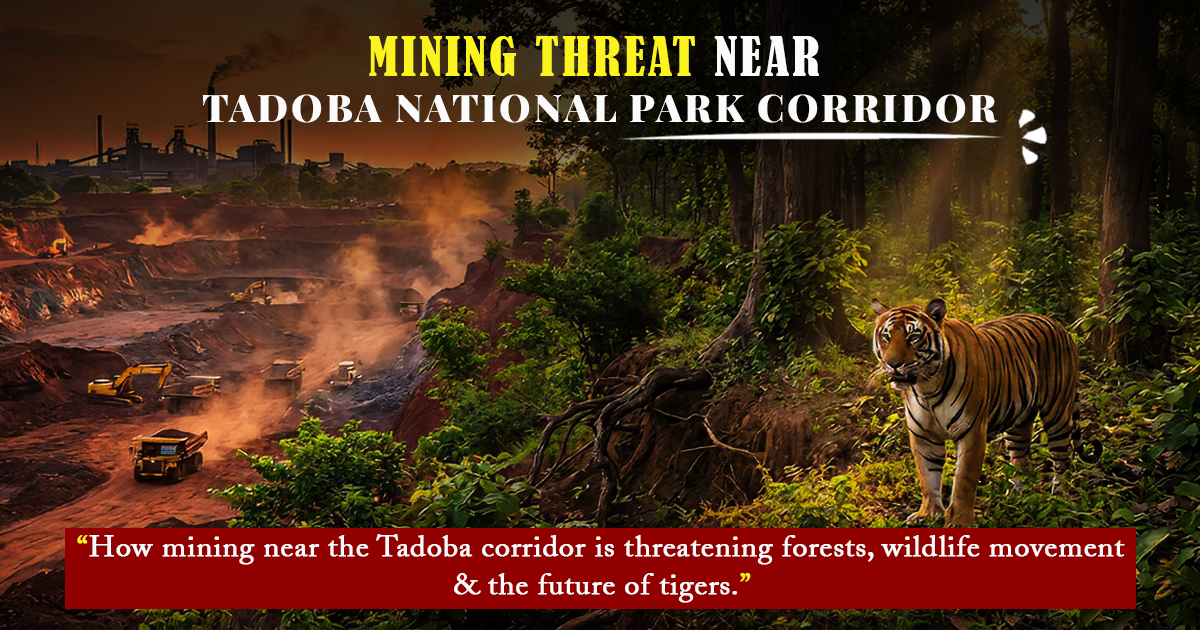
Mining Threat Near Tadoba National Park Corridor
A new iron ore mining project is proposed in Chandrapur district, Maharashtra. The selected location is very close to a forest corridor linked to Tadoba National Park. Tadoba is one of India’s most important tiger reserves. Due to the short distance between the mine site and the park, many concerns have been raised.
Environmental groups, wildlife experts, and nearby villagers are opposing the project. They say the mining can harm forests, block animal movement, and create safety risks for local people. For them, this issue is not only about development. It is about forest protection, wildlife survival, and environmental safety.
Because of these concerns, the matter is now before state and national wildlife authorities. The final decision will strongly affect Tadoba, its corridor, and dependent wildlife.
Where the Mining Project is Planned
The mining project is planned near Lohardongri village in Brahmapuri taluka of Chandrapur district. The land comes under Reserved Forest Compartment Number 439. This means it is legally protected forest land and is supposed to be kept safe from industrial activity.
The total land involved in this project is about 35.94 hectares. Even though this number may seem small, the location is extremely sensitive. This forest patch is not an ordinary forest area. It works as a natural corridor that connects the Tadoba–Andhari Tiger Reserve with the Brahmapuri–Gadchiroli forest region.
This forest connection is very important for wildlife. It allows animals to move safely from one large forest area to another. Animals need this movement for food, breeding, and survival. Any mining or industrial activity in this place will directly disturb a natural wildlife path that has existed for many years.
Importance of This Forest Corridor
Forest corridors are very important for animals. They allow animals to move safely in search of food, water, and mates. They also help animals move to new areas when their old areas become crowded or unsafe.
The corridor near Tadoba National Park is known to support around five tigers. It is also home to leopards, sloth bears, deer, wild dogs, birds, reptiles, and many other living species. Many of these animals depend on this forest strip to move between different forest regions.
This corridor supports the larger Tadoba forest system. It helps animal populations stay healthy by allowing genetic mixing. When animals can move freely, they can find new partners and new territories. Without such corridors, animal groups become separated. This separation can cause health problems, less breeding, and a higher risk of extinction over time.
This region is also closely linked to tourism. Many people visit this national park for Tadoba safari tours. Tourists come from different parts of India and from other countries to see tigers and other wildlife. Healthy forests and free animal movement are very important for Tadoba safari tourism. If the corridor is damaged, wildlife numbers may slowly reduce. This will directly affect tourism and the income of many local people.
What the Government and Committee Said
The Maharashtra State Board for Wildlife has given wildlife clearance to the mining proposal. After this state-level approval, the project will now go to the National Board for Wildlife. This national body will study the project and take the final decision.
Before giving approval, a three-member committee was formed to study the site. The committee visited the forest area and prepared a detailed report. The report included some recommendations and also serious warnings.
The committee said that mining should be allowed only if the full corridor area, which is more than 34,000 hectares, is officially declared as a protected wildlife sanctuary. This large area includes Ghodazari Wildlife Sanctuary and Ekara Conservation Reserve.
At the same time, the committee clearly warned that mining in this forest area would cause serious environmental damage. The report stated that wildlife would suffer permanent harm. It also warned about large-scale cutting of trees and heavy air and water pollution. These warnings are now a major part of the public discussion.
Why Activists and Groups are Against It
Opposition to the mining project is very strong. Many environmental groups, wildlife experts, and social organizations are speaking against it and trying to stop it.
They point out that about 36 hectares of reserved forest will be diverted for mining work. More than 18,000 trees are expected to be cut down. This will immediately change the local environment. Tree loss will affect temperature, rainfall absorption, soil strength, and water flow in the area.
There is also a serious fear of air and water pollution. Open mining produces a large amount of dust, which spreads into the air and nearby villages. Mining also creates waste material that can enter nearby streams and groundwater. This pollution can harm animals, plants, and people living close to the site.
Chandrapur district already faces problems of human–wildlife conflict. Tigers and other animals sometimes enter villages in search of food. Conservationists warn that destroying forests and breaking corridors will push animals even closer to human areas. This can increase attacks on livestock and also create danger to human life.
Groups like Jamaat-e-Islami Hind, Maharashtra, have openly opposed the project. They say that jobs from the mine will be limited and short-term. But the loss of the forest will be permanent. According to them, the environmental damage and social risk are much greater than the economic benefits.
What Happens Next and Why It Matters
The final decision will now be taken by the National Board for Wildlife. This board has the power to approve the mining project, change its conditions, or completely reject it.
Activists and conservation groups have said they will continue to oppose the project. Their main demand is full protection of the wildlife corridor. They also want the entire forest stretch to be officially declared as a conservation zone.
This decision is not only about one mine. It is about the future of wildlife in this region. It is also about the safety of nearby villages and the future of Tadoba safari tourism. Healthy forests are very important for Tadoba National Park and the animals living there.
What happens now will show how development plans are balanced with forest protection. It will also show how much value is given to wildlife, local communities, and long-term environmental health.
The decision taken at this stage will shape the future of this forest area and its animals for many years to come.


(0) Comments: